
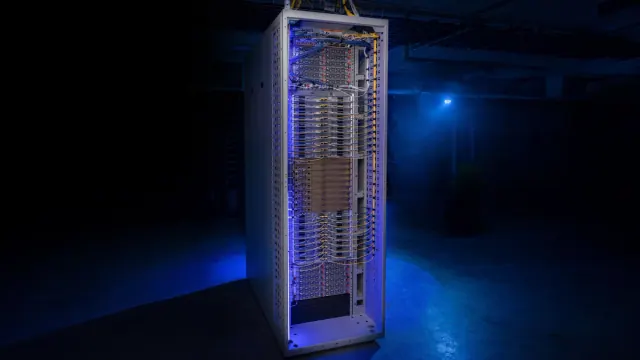
HUMAIN, AMD, and Cisco say their MI355X infrastructure is serving customers in Saudi Arabia. NVIDIA reports early Vera Rubin racks running at five cloud partners. OpenAI and its partners have broken ground on a planned 1 GW campus in Michigan. All three are infrastructure milestones, but they describe different levels of readiness.
Taken together, the announcements point to a wider test for AI deployment: whether chips, networks, power, software, and operating workflows can work together at the intended scale. A model score alone cannot answer that question, and a capacity commitment does not establish that a facility is ready to serve workloads.
From Model to Rack
NVIDIA and AMD are packaging more of the computing stack into integrated racks. NVIDIA's Vera Rubin NVL72 connects 72 GPUs through a 260 TB/s NVLink 6 fabric. AMD's Helios combines 72 Instinct MI455X GPUs, 18 sixth-generation EPYC CPUs, Pensando networking, and ROCm software.
The network matters for mixture-of-experts models, whose tokens move among distributed expert networks. NVIDIA presents rack integration as a way to handle that traffic. Its early deployments include CoreWeave, Google Cloud, Microsoft Azure, Oracle Cloud Infrastructure, and Nebius, with partner accounts describing different stages of validation and customer access.
Performance comparisons also use different methods. CoreWeave reported 10 times the DeepSeek-R1 token throughput per megawatt of Grace Blackwell NVL72 in a test on Vera Rubin hardware. AMD's claim of up to 30% more tokens per dollar than Vera Rubin NVL72 is an estimate using Kimi K2 Thinking, 32K input and 8K output lengths, and projected GPU pricing. Those results cannot be combined into a general ranking of production services.
From Rack to Operating Capacity
The Saudi deployment provides a clear example of phased expansion. The partners reported MI355X systems in production on August 31, but their next phase—up to 250 MW using MI400 hardware—is planned to begin deployment in 2027, with initial capacity expected online in the second half of that year.
OpenAI's Michigan project is at an earlier physical stage. Its June announcement marked groundbreaking on a planned 1 GW campus, with a closed-loop cooling design and a pledge to cover project power costs. It did not report operating compute capacity.
Commercial reservations sit alongside these construction plans. OpenAI's agreement with AWS includes approximately 2 GW of Trainium capacity across Trainium3 and Trainium4, with Trainium4 delivery expected to begin in 2027. The contract establishes a multi-year commitment, not a measure of current service availability.
From Planning to Robot Control
Robotics adds a different integration problem: turning model output into timely physical action. DeepMind's Gemini Robotics 2 family separates embodied reasoning, vision-language-action control, and an on-device model for local execution.
NVIDIA's Isaac GR00T reference humanoid combines a Unitree H2 Plus chassis, Sharpa hands with 22 degrees of freedom each, and Jetson AGX Thor onboard compute. Unitree plans availability for late 2026; NVIDIA also plans workflows for the smaller G1 robot so researchers can begin with existing hardware.
For readers assessing these announcements, the useful distinction is the disclosed milestone: a measured test, a running customer service, an early system installation, or a future delivery commitment. Each provides evidence about a different part of the path from AI development to routine use.