
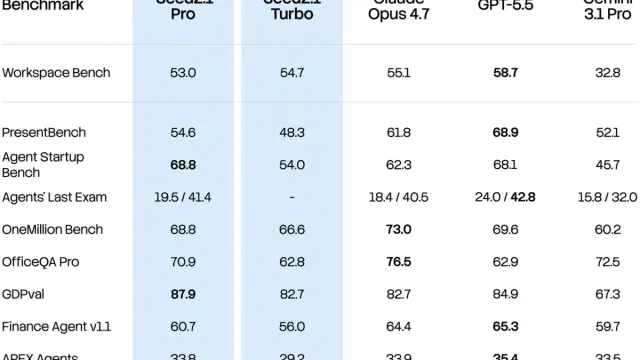
Users can now access the release as Doubao Seed 2.1 through two channels: enterprise developers connect via ByteDance's Volcano Engine cloud platform, while end users access it through the Doubao interface. The announcement did not detail standalone API pricing tables, token rate limits, or underlying parameter counts.
ByteDance framed Seed2.1 around end-to-end task execution across multiple applications rather than single-prompt conversational answers. According to the company, the model is built to transition among web browsers, document stores, code repositories, and local tools during extended workflows such as office project planning and software maintenance.
Cross-environment tool use and coding
To improve computer-use capabilities across mobile and desktop interfaces, ByteDance used reinforcement learning to guide action selection across graphical interfaces (GUI) and programmatic non-GUI spaces. The company claims this approach reduced the average number of steps required to finish tasks by 16% on the OSWorld benchmark, alongside claiming the top score on MobileWorld.
In workplace platforms such as Notion, Canva, and Figma, ByteDance reports that Seed2.1 coordinates direct GUI interactions alongside Model Context Protocol (MCP) tooling to break down instructions, generate design assets, and edit files. In internal evaluations, the company demonstrated the model synthesizing multi-view real-world photos into 2D floor plans and assembling slide decks from raw curriculum notes.
For software engineering, ByteDance positions the model as an end-to-end development agent supporting repository-wide dependency tracking, multi-file code editing, and bug fixing. In crowdsourced human preference testing on the Code Arena: Frontend leaderboard, ByteDance reported that, at announcement, Seed2.1 Preview scored 1539 to rank eighth overall, placing among the top 10 in five of seven frontend categories.
Multimodal processing and internal deployment
The update also adjusts multimodal analysis across long-form documents and dynamic video:
- Document understanding: ByteDance reported top benchmark scores on
CharXiv-RQandMeasureBenchfor chart reading, fine-grained visual reasoning, and numerical interpretation across dense multi-page PDFs. - Context and spatial tracking: The company highlighted results on
MMLongBench-128Kfor tracking extended task sequences, though the benchmark name itself does not define the model's actual architectural context limit. - Video analysis: On benchmarks including
TVBenchandTOMATO, ByteDance claims improved tracking of temporal motion dynamics, for video understanding tasks.
Internally, ByteDance is deploying the model in a closed-loop engineering framework dubbed Seed for Seed. Under this program, Seed2.1 agents assist the company's internal research pipeline by generating supervised fine-tuning data, diagnosing model performance, tuning reinforcement learning systems, and reproducing techniques from published papers. ByteDance notes that while the model has improved on long-horizon engineering tasks, open-ended research questions and cutting-edge mathematical problem-solving remain ongoing engineering challenges.