

Getting an AI agent to build a feature can feel like the end of a project. It is often the beginning of a different job: deciding whether the feature works, understanding what else it changes, and leaving enough information for someone to repair it later. A repository—the project’s stored files and recorded history—can remain intact while its owner gradually loses track of how the application works.
Advertisement
That is a useful way to read this week’s developer-tool deals. Conductor announced on November 4 that it is joining Meta. OpenAI announced a planned acquisition of Pierre, whose products include code-review components and Git storage. Neither announcement proves that these companies will maintain software better than GitHub. Both point toward products that help people manage the work around an agent’s output.
The opportunity is real: as generating changes becomes easier, understanding and accepting those changes becomes a more important part of the product. But the strongest test of this argument is GitHub itself. It is expanding its infrastructure and building tools for coordinating and reviewing agent work. Users therefore have several competing approaches to supervising generated work.
GitHub faces two different kinds of pressure
The expansion story has a factual basis. At Universe on October 28, GitHub said it had added four million CPU cores and 160 petabytes of high-speed storage during 2026. Its Octoverse report says that more than 40 percent of September pull requests started with an agent’s first draft, up from 17 percent in March. A pull request is a proposed change submitted for review and integration; this statistic does not measure the proportion of all code that AI wrote.
These figures establish activity and capacity demand. They do not establish that most GitHub projects are poor quality. A commit can contain a useful correction, generated scaffolding or an unsuccessful experiment. Counting commits cannot distinguish them. A claim about widespread bad code needs evidence about behavior, defects or maintenance, rather than a storage bill.
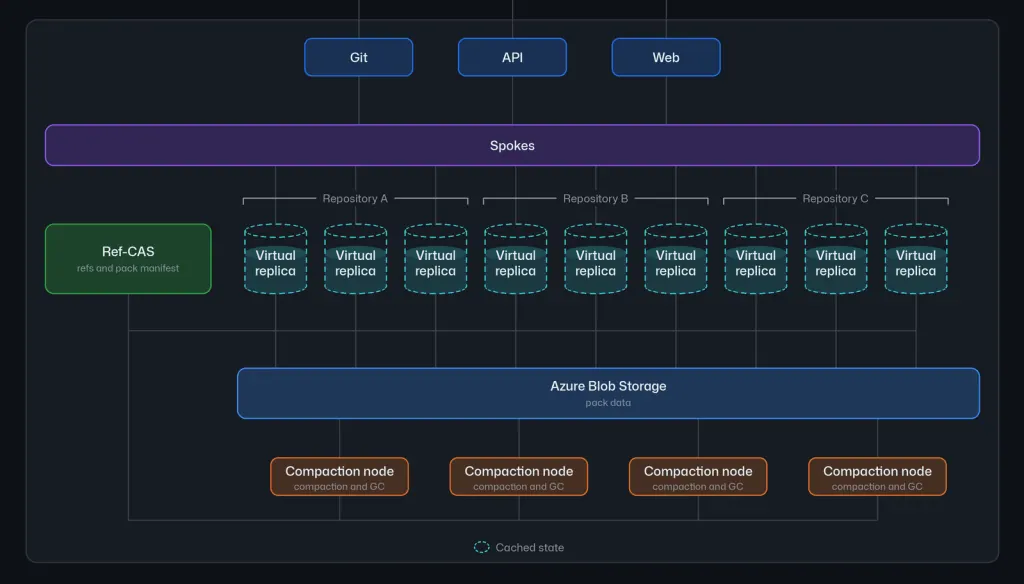
Karthik Raman and Brian Celenza’s November 5 engineering account, “Inside GitHub’s new Git storage architecture,” explains why Git, the version-control system that records a project’s changes, faces new demands. The problem includes many agents working in the same repository, not simply more people creating separate projects. A write can trigger further reads from build systems and other agents. GitHub describes separating computing work from durable storage to serve that concurrency while preserving familiar Git operations. Its reported test of 5,000 concurrent agents is an internal test, not a service guarantee for every customer.
That is the infrastructure pressure: keep changes moving reliably. The second pressure is human attention: decide which changes deserve to move. More storage can help preserve an experiment; it cannot tell a maintainer whether the experiment should become part of the product. A platform needs ways to make that decision understandable as well as ways to carry its traffic.
The quality evidence deserves a narrower claim
Kerno’s October study offers a reason to investigate maintenance without declaring GitHub a junkyard. It examined 46 selected codebases, mostly commercial open-source projects and predominantly TypeScript. Among repositories with an identified AI adoption date, the median number of decision points per 100 new lines rose from 5.2 before adoption to 8.1 afterward. That suggests more branching logic for a reader to understand.
The findings were mixed: the share of code rewritten within 90 days fell from 18 to 12 percent, and the share of testing-related commits increased. This was an observational, nonrandom sample, not an experiment establishing causation. The researchers lacked production-defect and incident data, and Kerno sells related developer tools. It cannot tell us that most generated code is defective, or that every team now spends longer maintaining it.
These results give teams a reason to check whether faster generation leaves more complexity for reviewers and future maintainers. That question remains worthwhile even when AI produces good code. Correct work still needs a purpose, a place in the system and someone able to change it later.
What Conductor contributes, and what Meta has not announced
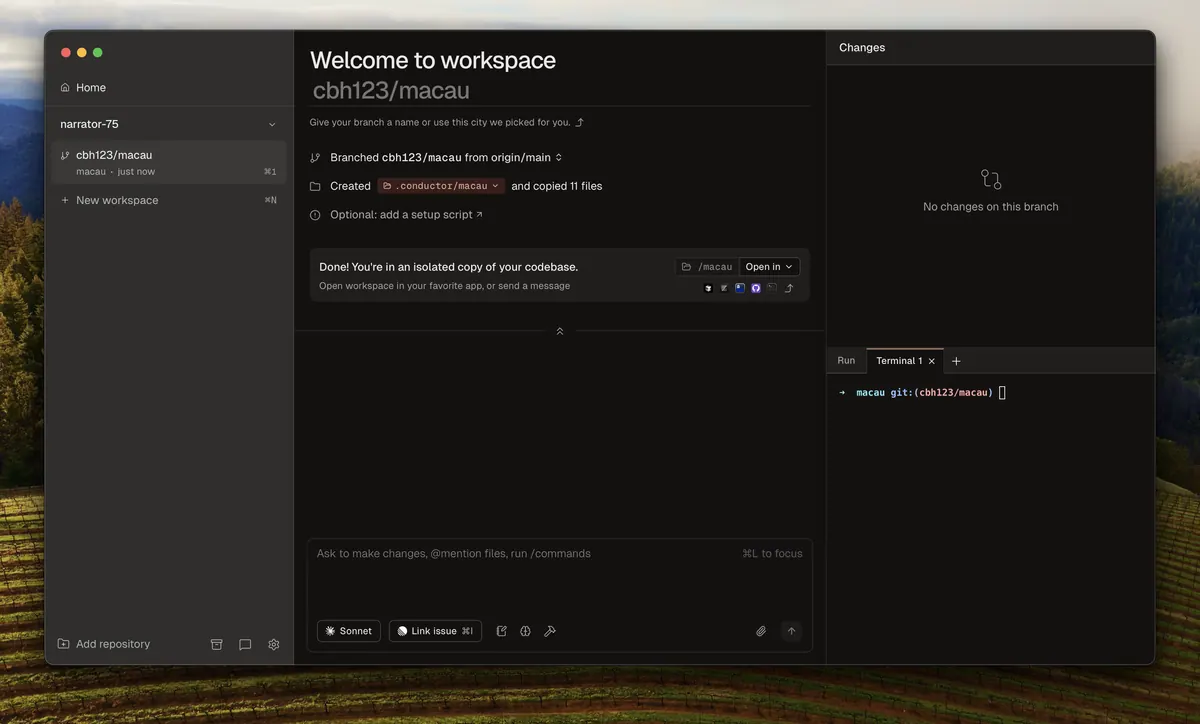
Conductor’s existing product organizes parallel agent work into workspaces. Its documentation describes separate Git working trees, branches, files and task context. In plain language, a task gets its own working copy and line of development. This helps people keep several changes apart while they inspect and run them. Local isolation is a development convenience, not a security boundary.
Imagine an agent fixing a checkout bug while another changes an account screen. Separate workspaces reduce the risk of both editing the same working files. They also make it easier to return to the checkout task and find its conversation and changes. They do not prove the two finished features will work together. Shared components still need attention when the changes are integrated.
Conductor’s workflow guide explicitly includes reviewing changes, checking the running application, running checks and resolving conflicts before merging. The user benefit is a clearer path from delegation to inspection. Such an interface could reduce the bookkeeping needed to supervise agents, provided the developer still has a manageable amount of work to review. Launching more simultaneous tasks is not automatically a maintenance improvement.
Meta’s next product remains undisclosed. Conductor says it expects something new early next year; that is insufficient evidence to promise particular review features, model support or pricing. Existing users face a nearer decision: Cloud becomes read-only November 13 and shuts down November 20, when deletion of cloud data begins. Local updates continue until early 2027 before the local product winds down. No exact local shutdown day is given.
The company offers cloud-to-Mac transfer, data export and refunds for active subscribers. These are meaningful continuity options. New sign-ups have stopped, so this is not a recommendation for newcomers to buy Conductor now. One participant in the original community discussion asked about continuity for a small cloud-based team. That is an individual concern, not evidence of a universal migration failure. It does illustrate why maintenance includes keeping unfinished work usable when the tool around it changes.
What Pierre could bring to OpenAI’s workflow
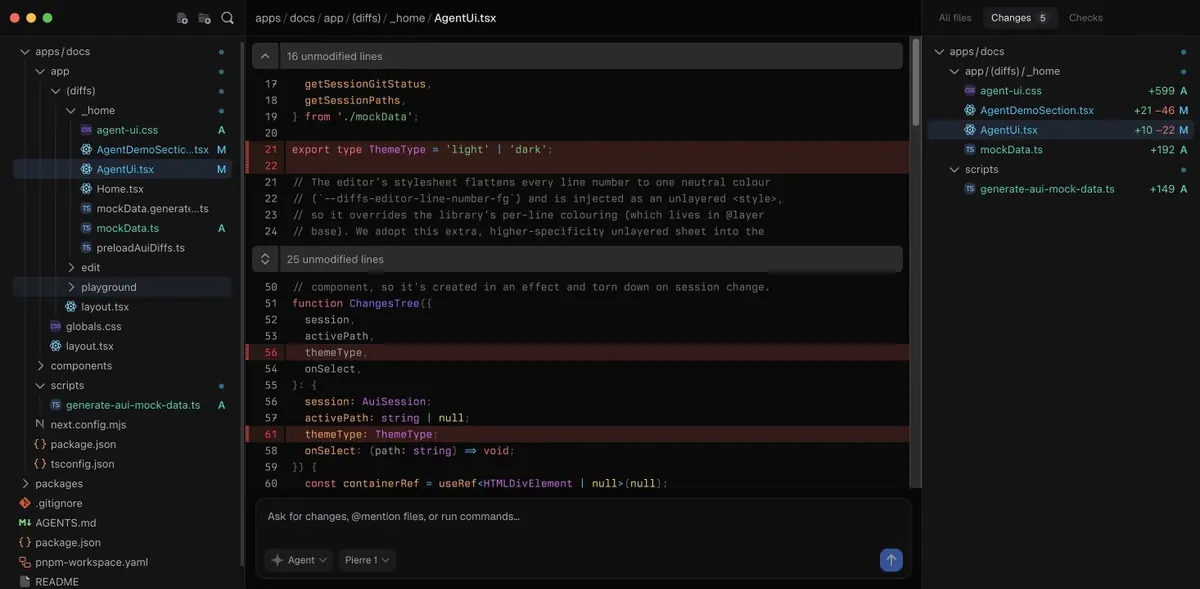
Pierre addresses another part of the job: seeing and responding to changes. OpenAI says Pierre’s Trees and Diffs libraries already power file browsing and change review in Codex. Diffs offers editing inside the view of changed code, as well as annotations and controls for accepting or rejecting changes. A reviewer who notices a problem can act where the problem is displayed.
Consider the checkout example again. An agent has changed a function that calculates a discount. An interface showing the old and new versions makes the modification easier to inspect; editing there can shorten the correction process. But the important question might be whether refunds use the same calculation elsewhere. A polished display cannot answer that question on its own. The reviewer needs surrounding code and a clear statement of the intended behavior.
Pierre also operates Code Storage, a programmable Git service for applications that need to store code and its history. It offers software interfaces, ordinary Git access and synchronization with other services. Its commercial model distinguishes storage and bandwidth usage. It is a different product from a consumer subscription to an AI assistant, and acquisition news does not establish a future bundled price.
OpenAI says Code Storage will remain available after closing and Pierre’s open-source projects will remain open-source. The transaction still requires customary closing conditions, including regulatory approval; the companies remain separate until then. Bringing storage and review closer to Codex could make it easier to carry a task from initial change through correction. That is a plausible benefit of integration, not measured evidence of better code quality or an announced requirement to leave GitHub.
GitHub is working on the maintenance problem too
GitHub’s response extends beyond buying hardware. Projects in the Copilot app, currently in public preview, organize an ongoing goal across repositories, sessions and recurring tasks. They let users supply supporting material and return to related work over time. This directly overlaps the problem of remembering what an agent is doing and why, rather than treating every prompt as an isolated request.
Copilot automations can run on a schedule or in response to repository events. GitHub gives examples such as trying to reproduce a reported bug and capturing screenshots for review. Availability matters: these automations currently require an eligible paid Copilot plan and a private or internal repository, with the necessary policies enabled. They are not a general maintenance facility available on every public GitHub project.
GitHub also offers Copilot code review on paid Copilot plans, including a Max effort level, and documents repository-context gathering to improve the relevance of feedback. Its billing separates AI credits from Actions minutes used for agentic capabilities. More intensive review therefore has a resource cost; it should be judged by useful findings, not chosen solely because its name sounds more thorough. Suggested fixes still need validation.
GitHub Code Quality adds a different kind of check: CodeQL code-analysis rules flag known patterns on pull requests, while uploaded coverage reports can support thresholds that block a merge. It also scans existing code on the default branch. The product is for GitHub Team or Enterprise Cloud, with license and usage costs. This makes an important distinction: an AI reviewer’s suggestions and a configured rule or coverage gate provide different kinds of evidence. Neither establishes that an application meets every user requirement.
Another response is less glamorous: stacked pull requests break a large change into smaller dependent proposals that can be reviewed and merged separately. This addresses a practical problem with agent output. A working demonstration may conceal an enormous bundle of decisions. Dividing the work can make each decision easier to assess, although the combined behavior still needs checking.
These tools weaken any simple prediction that Meta or OpenAI will win because GitHub only stores files. GitHub’s potential advantage is connecting agent work to the place where many teams already review and integrate changes. An AI application’s potential advantage is keeping the task, conversation and correction process together from the beginning. Which feels simpler depends on the user’s actual project and team.
The two can coexist. A developer might spend more time in Codex while the shared repository remains on GitHub. Winning the interface through which people direct their work does not require replacing the service that holds its history. The announcements establish competition over more of the workflow, not a settled replacement of one platform by another.
A project should remain understandable after the chat ends
For a solo builder or small team, the immediate lesson is to change what counts as “finished.” The following is a proposed working method, not a claim that any of these products automatically enforces it. Return to the hypothetical discount feature and ask what would let someone safely modify it three months from now.
First, record the intended behavior beside the work: who receives the discount, which purchases qualify and what happens during a refund. Give the agent a bounded change. A small proposal with a clear purpose is easier to question than a broad request to improve the entire checkout system. If the task grows, divide it into understandable steps before asking a reviewer to approve it.
Next, require evidence that addresses those requirements. Running tests is useful, but a green result is only informative if the checks exercise the behavior that matters. For this example, inspect ordinary purchases, boundary cases and the refund path. An AI reviewer can suggest missing cases; the owner should check that those suggestions correspond to the product’s rules. Asking a second agent to agree with the first is not sufficient evidence by itself.
Then leave a concise handoff in the repository or pull request: what changed, why, what was checked and what remains uncertain. Keep instructions for running the application current. There is no need to preserve every conversational detour. Preserve the decisions that another person would otherwise have to reconstruct, especially where the code implements a business rule that is not obvious from its syntax.
Finally, keep ownership after release. Someone should know how to recognize a failed rollout, restore the previous working version and handle dependencies or services that change later. A dormant experiment can be marked as such instead of looking like a supported product. For an active application, maintenance should appear as actual work with an owner, not a vague promise attached to the last generated commit.
This also supplies a useful way to compare tools. On similar tasks, track how much human review is needed, which meaningful defects escape, how much rework follows and whether someone can resume the project without reconstructing its history. Include subscription, usage and migration costs. These are proposed evaluation criteria; the acquisition announcements provide no comparable results on them.
Meta and OpenAI have opportunities to make supervision and correction easier. GitHub has both infrastructure work and its own product response underway. The durable advantage will belong to tools that help users keep software understandable and working as it changes. Generating more code makes that job more consequential; it does not tell us who has already won it.