
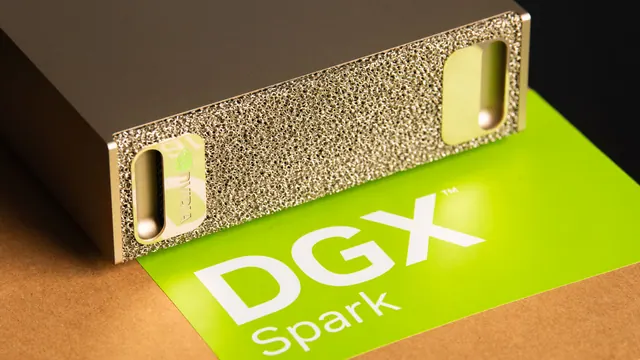
NVIDIA's DGX Spark once offered 128GB of unified memory for $3,999. The newly announced 64GB configuration starts at $4,999: half the memory for roughly 25% more money. Meanwhile, the original 128GB system has climbed to about $7,000 in October reporting. I see a deterioration in the buying proposition here, even if the smaller machine remains useful. The memory that made Spark attractive has become more expensive to obtain and harder to justify cutting.
Advertisement
This is the uncomfortable reality of the memory shortage on a developer's desk. A lower-capacity option can reduce today's entry cost without restoring yesterday's value. For someone who needs local NVIDIA hardware now, that compromise may be unavoidable. For someone buying mainly to explore what future models might do, it deserves considerably more hesitation.
The Price History Changes the Meaning of Affordable
The original 128GB DGX Spark went on sale in October 2025 at $3,999. By February 2026, NVIDIA had raised its reference system's recommended price to $4,699. Its official price-change notice explicitly blamed worldwide memory supply constraints and said the hardware configuration had not changed.
The October step is larger. Tobias Mann's October 2 report in The Register puts the 128GB price at $6,950, nearly 74% above launch. HotHardware reports $6,995 and notes inconsistent cached pricing on NVIDIA's website. The exact reported figures differ, but both place the reference system around $7,000. Individual retailer prices and actual availability can differ again.
Against that new baseline, $4,999 looks like relief. Against the original launch, it means paying another $1,000 while surrendering 64GB. Mann's emphasis on the combined price rise and capacity cut is the useful starting point for judging this announcement. The relevant question is how much of Spark's original attraction survives the compromise.
| Configuration and price reference | Unified memory | U.S. price |
|---|---|---|
| Original NVIDIA system, October 2025 launch | 128GB | $3,999 |
| Same reference system, February 2026 adjustment | 128GB | $4,699 |
| Reference system, October 2 reporting | 128GB | $6,950 in The Register; $6,995 in HotHardware |
| New partner configuration, planned October 23 availability | 64GB | Starting at $4,999 |
The 64GB option is a new configuration of the GB10 platform, not a new processor generation replacing the old one. NVIDIA retains the Grace Blackwell chip and software environment. Its specifications list 273 GB/s memory bandwidth and ConnectX-7 networking at 200 Gbps. Reducing capacity does not halve every aspect of performance, but it removes room that a larger workload might need.
That distinction matters because a developer is buying the ability to run an application, not an isolated processor specification. A machine can keep the same compute hardware and become a less flexible purchase when the amount of memory attached to it falls. At this price, flexibility is a substantial part of what buyers are giving up.
Smaller Models Help, but MoE Does Not Erase the Memory Limit
There is a valid case for 64GB. A known local agent or inference task may not require anything close to 128GB. Improvements in smaller models can make a compact machine more useful without a larger memory allocation. NVIDIA's October announcement emphasizes that opportunity, including Qwen3.8 27B and applications built around local agents.
The difficulty appears when the buyer wants to experiment with larger models, longer conversations or several simultaneous requests. Memory must accommodate more than the model's nominal parameter count. Runtime allocations and the context cache also consume space. Choosing a model that barely fits its weights leaves a different operating margin from choosing one that fits the complete workload comfortably.
Mixture-of-experts, or MoE, models deserve particular care. They route each token through only part of the model, reducing the computation required relative to activating every parameter. They can therefore be attractive for local inference. But the inactive experts have not disappeared: in a conventional fully resident deployment, their weights still occupy memory. Sparse computation does not make the active-parameter count a reliable memory-sizing figure.
Qwen's published Qwen3-30B-A3B model card provides a concrete illustration: 30.5 billion total parameters, with 3.3 billion activated. Storing 30.5 billion parameters at two bytes each requires about 61GB for weights alone. At an idealized four bits per parameter, the arithmetic falls to about 15.25GB before quantization metadata and runtime overhead. Those are storage calculations, not measured Spark memory usage or a guarantee of a particular context length.
A suitably quantized, modest-size MoE can consequently be a reasonable match for 64GB. A much larger MoE does not become suitable merely because its active parameter count is small. Quantization, total model size, context and runtime support must work together. The practical benefit comes from a specific model configuration, not from the MoE label by itself.
I would be especially cautious about buying the smaller Spark as an open-ended research machine. If the intended job already fits, unused memory has limited immediate value. If the job is to keep trying larger models, the missing 64GB is precisely the resource that preserves choices. The new price makes that loss harder to dismiss as an inexpensive compromise.
A Cluster Recovers Capacity at a Much Higher Entry Cost
Connecting two smaller systems provides a route around the single-machine limit, but it does not recreate the old buying proposition. Two units at the announced starting price total $9,998 before separately charged accessories, tax or shipping. Their combined 128GB matches the original machine's memory capacity while spreading it across two computers.
The pair also supplies two GB10 processors. That additional hardware can be useful, so a memory-only comparison is not a complete performance judgment. Yet a buyer who needs capacity rather than another processor must still pay for the whole second system. NVIDIA's configuration table also lists two 128GB machines with 256GB in aggregate. Halving memory per node reduces the capacity reached with the same number of boxes.
For getting a larger model running with fewer machines, the original 128GB configuration retains a practical advantage. This does not establish that it wins every throughput comparison. It establishes that it reaches a given memory total without distributing that total across as many nodes.
Software adds another condition. NVIDIA Sync's Cluster Assistant configures the network between supported machines; its documentation says inference and fine-tuning workloads require separate setup. A forthcoming Model Launcher may simplify supported deployments, but buying a cable does not make every runtime use distributed memory automatically.
The cluster option remains valuable for work that benefits from it. I would no longer use it as a reassuring answer to a capacity shortfall in the first purchase. At nearly $10,000 for two entry units, the remedy needs its own budget and a demonstrated application benefit.
The Supply Outlook Offers No Reliable Relief Date
The broader market helps explain why manufacturers are offering such compromises. In its September 30 outlook, TrendForce projects conventional DRAM contract prices rising another 10–15% in the fourth quarter and NAND flash prices rising 15–20%. It says suppliers continue to prioritize advanced manufacturing capacity for server products, keeping the wider market undersupplied. These are market forecasts, not a breakdown of NVIDIA's component costs.
Memory and storage also need to be distinguished. Spark's unified LPDDR5X memory holds working data for the CPU and GPU; its SSD uses a different type of memory for storage. Pressure on both markets can raise system costs, but a forecast for NAND cannot automatically establish when the price of Spark's working memory will fall.
TrendForce's July outlook expected DRAM to remain constrained in 2027, with significant contributions from new capacity arriving in 2028. It also described how high-bandwidth memory production absorbs manufacturing resources. In the same outlook, it anticipated a looser NAND market in the second half of 2027. Even within one forecast, the two markets did not share a single recovery date.
Micron's newer assessment is more pessimistic. On its September 30 earnings call, CEO Sanjay Mehrotra said the company expected memory and storage supply-demand conditions to tighten further in calendar 2027 and 2028. The transcript records no clear date for supply catching demand. He also explained that initial production from a new factory takes additional quarters to become a meaningful supply contribution.
That is a supplier's forecast, and it should be read as one. Micron sells into the market it describes; its outlook is not a promise that prices will move only upward. Nevertheless, it gives buyers little basis for treating late 2027 or 2028 as a dependable return to affordable memory. New factories coming online and a shortage ending are different events.
AI demand complicates the timing further. More capable small models can reduce the resources needed for one task, while larger deployments and more concurrent agents increase total demand. Efficiency in an individual application does not ensure falling demand across the industry. The expansion of AI infrastructure currently provides no reliable endpoint around which a desktop buyer can plan.
I read the 64GB Spark as an accommodation to those conditions. It keeps a lower-priced configuration available while memory remains expensive. The public evidence does not reveal how much of the retail increase reflects components, margins or other costs, so it cannot establish that this exact price was unavoidable. For buyers, however, the reduced capacity and higher bill are already concrete.
Early Buyers Did Well; New Buyers Need a Stronger Reason
Someone who bought the original 128GB machine for $3,999 secured twice the memory of the forthcoming $4,999 entry model for $1,000 less. In purchasing terms, that was fortunate timing. Existing owners also retain the larger single-machine capacity. This is a benefit in usable hardware and avoided replacement cost, rather than evidence of a realized resale profit.
The 128GB configuration has not vanished from the market. When checked on October 3, SHI listed a 128GB PNY-supplied DGX Spark at $5,824 with stock indicated, although its search listing marked the inventory update as more than seven days old. B&H listed the NVIDIA reference unit at $5,299 but marked it temporarily out of stock. Such listings show why a reported reference price should not substitute for an available retailer quote.
If a genuine 128GB offer remains close to the price of the new 64GB unit, it deserves consideration from a buyer who already needs local NVIDIA hardware. Confirm the exact configuration, deliverable stock and support terms. A cheaper listing that cannot ship is not an alternative, and remaining inventory is not a reason to buy an otherwise unnecessary machine.
My recommendation is therefore more cautious than Spark's original memory proposition might suggest. For a specific, urgent workload that has been validated on the intended configuration, the machine can still earn its cost. For discretionary experimentation, the combination of higher prices and reduced capacity makes a purchase harder to recommend. Keep using suitable existing hardware and define the job before committing thousands of dollars to a smaller system.
Waiting does not guarantee a lower price next year. It does preserve the choice to spend when the work justifies it. The memory shortage may persist through the dates now appearing in industry forecasts, and AI infrastructure demand has no visible, dependable finish line. That uncertainty should raise the standard for a purchase—not turn fear of the next price increase into the main reason to buy.