
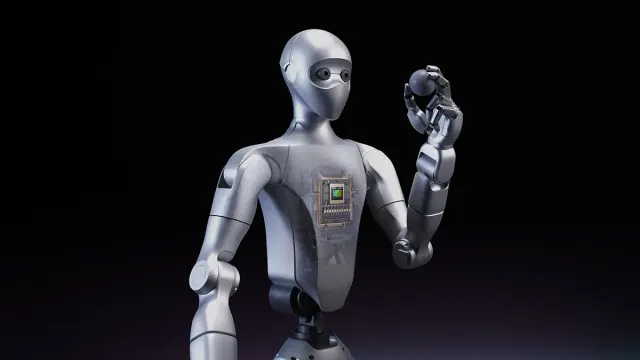
Announced at GTC Taipei, the NVIDIA Isaac GR00T Reference Humanoid Robot packages physical hardware, edge processing, and development workflows into an open reference architecture for academic laboratories. The system targets the fragmented pipeline across hardware integration, data collection, simulation, training, evaluation, and physical deployment. According to NVIDIA, research teams retain ownership of their training data, telemetry, robot data, and logs.
Hardware Architecture and Processing
The platform pairs a full-scale humanoid chassis from Unitree with tactile five-finger hands from Sharpa and an onboard edge processor from NVIDIA.
| Component | Specification / Supplier | Research Function |
|---|---|---|
| Robot chassis | Unitree H2 Plus (~6 ft, 150 lbs, 31 DoF) | Human-scale locomotion and gross body motion |
| Hands | Dual Sharpa Wave (22 DoF each) | Tactile sensing and dexterous manipulation |
| Onboard compute | NVIDIA Jetson AGX Thor T5000 | Real-time sensor processing, inference, and whole-body control |
| Vision & sensing | Stereo head camera (140° H / 102° V), wrist cameras, IMU | Multi-view visual perception and motion tracking |
| Actuation limits | Arm torque: 120 Nm; Leg torque: 360 Nm | Rated arm payload of 7 kg (15 kg peak) |
| Connectivity | Ethernet, Wi-Fi 6, Bluetooth 5.2, USB, mic/speaker array | System telemetry, data transfer, and voice interaction |
The onboard Jetson AGX Thor T5000 system features a Blackwell GPU delivering a vendor-claimed 2,070 FP4 teraflops of AI performance, alongside a 14-core Arm CPU, 128GB of unified memory, and a configurable 40- to 130-watt power envelope.
Workflow Integration and Phased Access
The Isaac GR00T platform spans data generation, simulation, policy learning, and edge deployment. Rather than requiring teams to adopt the full stack, its modular design allows research groups to plug specific Isaac GR00T tools into existing pipelines. Partner institutions slated to test the reference design include Ai2, ETH Zurich, the Stanford Robotics Center, and the UC San Diego Advanced Robotics and Controls Laboratory.
Delivery is divided into two separate tracks:
- Unitree G1 workflow: NVIDIA plans to release reference workflows soon via GitHub and Hugging Face for the smaller, widely adopted Unitree G1 robot, allowing teams to test the Isaac GR00T stack ahead of full-scale hardware availability.
- Unitree H2 Plus reference robot: Unitree plans to make the complete physical humanoid reference system available in late 2026.
The announcement did not specify pricing or exact release dates for the reference workflows.