
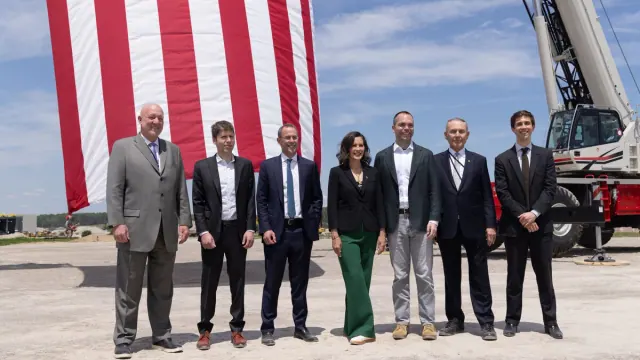
OpenAI has broken ground on "The Barn," a planned 1-gigawatt data center campus in Saline, Michigan. Developed alongside Oracle, Related Digital, and Walbridge, the project marks a physical construction phase under OpenAI's Stargate infrastructure program. The groundbreaking establishes building activity rather than active computing capacity; the announcement did not specify a completion timeline, phased energization milestones, or hardware deployment dates.
Power, water, and community commitments
To address community impact concerns common to large-scale data center construction, the development partners announced several resource commitments:
- Ratepayer protection: OpenAI pledged that the project will self-fund the necessary power and infrastructure investments, asserting that costs will not be passed along to local ratepayers or increase resident electricity bills.
- Water usage: The site plan relies on a closed-loop cooling design projected to consume roughly the same volume of water as a typical office building.
- Civic funding: OpenAI, Related Digital, Oracle, Walbridge, and Blackstone committed a combined $10 million toward improvements for the Saline Recreation Center.
OpenAI also cited an estimated $1 billion in tax revenue generated across the facility's lease term to support local, county, and state public services.
Projected labor and educational programs
The physical buildout links to a broader partnership with North America’s Building Trades Unions (NABTU) for skilled trade labor and union-registered apprenticeship programs. Across the life of the project, OpenAI projects:
- More than 2,500 union construction jobs;
- 450 permanent onsite positions;
- 1,500 county-wide jobs alongside approximately 1,000 indirect roles.
These employment numbers represent forward-looking vendor estimates rather than current operational payrolls.
Alongside the site work, OpenAI announced state-level educational initiatives for the 2026–2027 academic year. The company plans to distribute up to $45 million in Codex credits to over 400,000 eligible college, community college, and trade school students aged 18 and older in Michigan. It is also partnering with the Michigan Department of Labor and Economic Opportunity and local community colleges on workforce-oriented AI training curricula.