
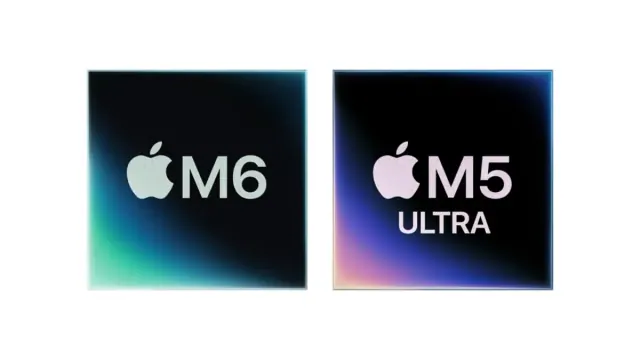
Apple announced the M6 chip in a refreshed Mac mini and the M5 Ultra in the Mac Studio on August 25, 2026. The announcement establishes two distinct tiers for local AI execution: a compact desktop using Apple's first chip fabricated on a 2-nanometer process, and a workstation-class processor connecting four dies to address up to 512GB of shared memory.
Architectural Split: Monolithic 2 nm vs. Quad-Die Interconnect
The two systems divide developer workloads by hardware architecture, unified memory capacity, and throughput:
- M6 in Mac mini: Built on a single 2 nm die, the
M6features a 12-core CPU (2 super cores, 4 performance cores, and 6 efficiency cores), a 12-core GPU with per-core Neural Accelerators, and a Dual 16-core Neural Engine. It supports up to 32GB of unified memory with bandwidth reaching 170GB/s. - M5 Ultra in Mac Studio: Apple’s first quad-die architecture links two dual-die
M5 Maxprocessors using next-generationUltraFusionpackaging. The company reports over 4.4TB/s of inter-die bandwidth, allowing the assembly to function as a single system on a chip. It incorporates an up-to-36-core CPU (12 super cores, 24 performance cores), an up-to-80-core GPU with Neural Accelerators, a 32-core Neural Engine, up to 512GB of unified memory, and up to 1.2TB/s of memory bandwidth.
Implications for Local AI Workloads
For practitioners evaluating local inference and fine-tuning, hardware memory constraints dictate deployment viability:
On the M6, the 32GB memory ceiling limits the size and precision of models that can run locally, as system memory must also accommodate the operating system and running applications. Apple claims the Dual 16-core Neural Engine provides up to twice the peak compute of prior generations, while the GPU’s Neural Accelerators deliver a nearly 30 percent increase in peak GPU AI compute compared to the M5.
On the M5 Ultra, Apple claims the 512GB unified memory pool and 1.2TB/s bandwidth enable users to run large language models with hundreds of billions of parameters entirely on device. The vendor reports up to 4.5 times the peak GPU AI compute of the M3 Ultra. However, these peak architectural figures represent theoretical hardware capability rather than guaranteed tokens-per-second generation speeds, which vary based on quantization, runtime optimizations, and specific model architectures.
Both chips integrate with Apple developer tools including Core AI, Core ML, Metal, and Xcode.