
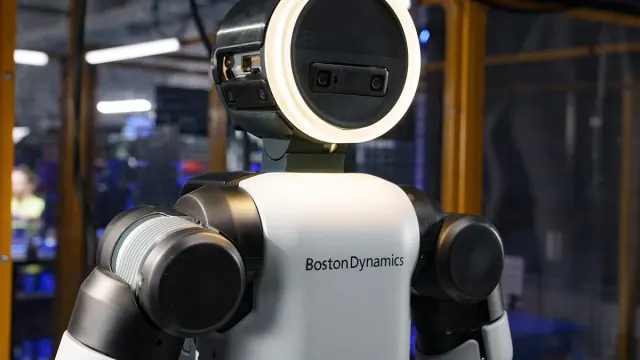
Boston Dynamics formally transitioned its electric Atlas humanoid from a research project into a commercial product at CES 2026 in Las Vegas. The company stated that production is starting immediately at its Boston headquarters, but broader market availability will not begin right away: its entire planned deployment output for 2026 is already committed to Hyundai’s Robotics Metaplant Application Center (RMAC) and Google DeepMind. The company plans to open deliveries to additional customers in early 2027.
Production Hardware and Automated Servicing
Designed for enterprise deployment in sectors such as automotive manufacturing, material handling, and order fulfillment, the Atlas product design shifts from bespoke research mechanics to automotive-compatible components. Boston Dynamics claims the design reduces unique part counts, supported by a partnership with Hyundai Mobis to supply and co-develop actuators.
According to Boston Dynamics, Atlas features 56 degrees of freedom, fully rotational joints, a reach of 2.3 meters (7.5 feet), and an advertised lift capacity of up to 50 kg (110 lbs). The chassis is rated for operating temperatures between -20°C and 40°C (-4°F to 104°F) and is described as water-resistant.
To eliminate manual battery charging stops, Boston Dynamics designed Atlas to autonomously navigate to a charging station, swap out its own battery pack, and resume operational tasks. The robot connects to enterprise warehouse management systems (WMS) and manufacturing execution systems (MES) through Boston Dynamics' Orbit software.
Control Stack and Scaling Plans
Atlas supports three operating control modes: fully autonomous operation, teleoperation, and a tablet-based steering interface. The company claims that once a single unit learns a specific industrial task, that routine can replicate instantly across an entire fleet.
To expand the robot's cognitive capabilities, Boston Dynamics announced a collaboration with Google DeepMind to integrate foundation models for varied industrial workloads, beginning in automotive plants. Long-term manufacturing scale is closely tied to majority owner Hyundai Motor Group, which stated it is preparing to deploy tens of thousands of Boston Dynamics robots across its facilities. Hyundai also announced plans to construct a U.S. robotics manufacturing plant capable of producing 30,000 units annually as part of a broader $26 billion domestic investment plan.