
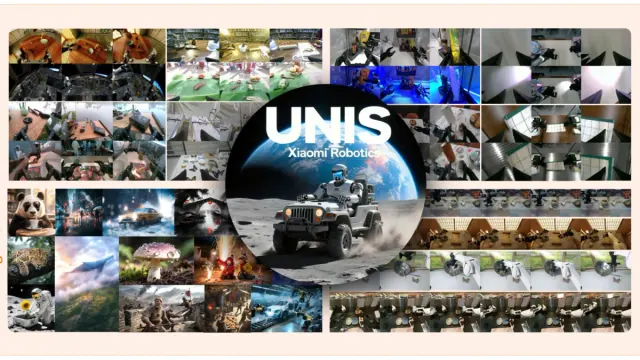
The project targets robot learning workflows constrained by small physical demonstration sets. Rather than training solely on robotic motion trajectories, the single autoregressive framework unifies text-to-image synthesis and multi-frame embodied video generation within a shared multimodal vocabulary. Visual inputs are discretized using an IBQ image tokenizer, mapping image and text tokens into the same representational space under standard next-token prediction.
Decoding Acceleration and Scene Transfer
Dense visual autoregression typically suffers from high inference latency. To address this, Xiaomi introduced FlashAR+, an anti-diagonal parallel decoding scheme designed to replace conventional token-by-token generation. Paired with vLLM paged key-value cache scheduling, Xiaomi reports that single-sample generation latency for 1024×1024 images dropped from 450.77 seconds to 5.44 seconds—an approximately 82.9-fold speedup in that reported setup.
For robot training data generation, the model decomposes embodied scenes into independent attributes, such as lighting, background, and objects. Xiaomi states these factors can be recombined from compact descriptions without altering robot poses or manipulation states. On internal benchmark comparisons, Xiaomi claims the model achieved higher multi-view consistency in embodied scene generation and stronger transfer robustness than GPT-Image-2, while maintaining comparable instruction-following performance.
Video Rollout and Data Augmentation
The model also functions as a trajectory simulator. Given an initial frame, a language prompt, and an action input, Xiaomi-Robotics-U0 generates multi-frame embodied video rollouts sampled at 1, 3, or 5 frames per second. Generated scenes can also serve as starting frames for subsequent video rollouts. On the EWM benchmark, Xiaomi reported that the architecture (listed as UNIS) attained a top-ranking Score_P of 73.64 across evaluated world models.
To augment physical robot training, Xiaomi applies synthetic style-transfer data to real demonstrations during policy post-training, aiming to improve policy robustness against unseen backgrounds and varying illumination. All benchmark rankings, latency improvements, and downstream policy gains stem directly from Xiaomi's published claims and technical report; these results do not by themselves establish transfer performance across other robot hardware.